
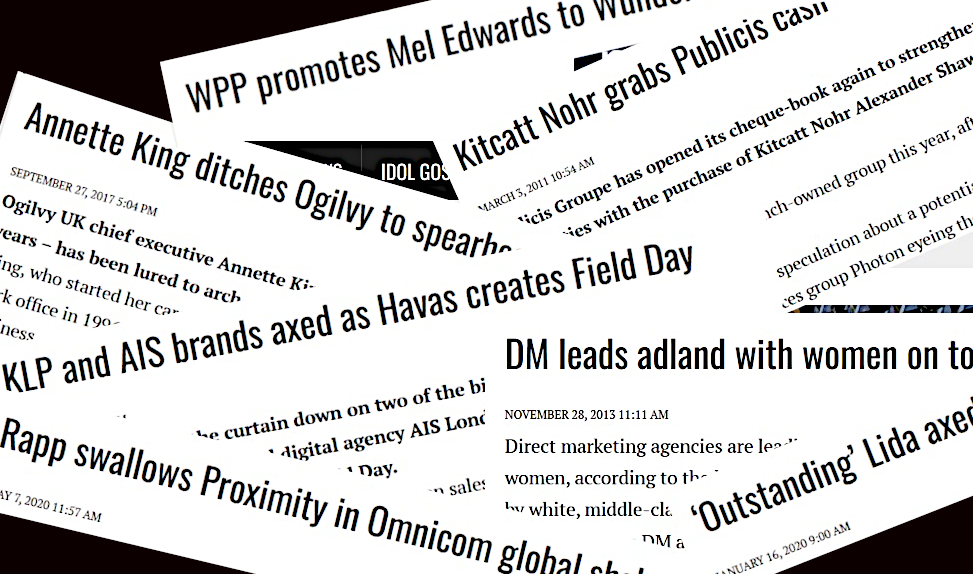
 With adland seemingly going into mass mourning due to Omnicom “retiring” established advertising agency brands DDB, FCB and Mullen Lowe, it is water off a duck’s back to people who have spent their careers in data-driven and direct marketing agencies.
In fact, you only have to compare the businesses which were at the top of their game back in 2010 with those of today to see just how many brands have gone to the agency graveyard in the sky yet nearly all of their bosses and founders have gone on to greater things.

Of course, by this time many of the industry’s “trailblazers” like John Watson, Drayton Bird, Terry Hunt and Judith Donovan were being followed by the next generation of “middle-aged guns” who had cut their teeth at bigger agencies and decided that they could do a better job by launching their own start-ups.
The likes of Vonnie Alexander, Marc Nohr, Paul Kitcatt, Simon Hall, Chris Barraclough, Elly Woolston, Stuart Archibald, Steve Stretton, Steve Aldridge, Phil Andrews, Ben Stephens, Chris Whitson and Chris Ward all trod this path.
Then there were the ones who stayed on to climb the ladder, like the late Mike Dodds, Annette King, Lisa Thomas, Mel Edwards, Nicky Bullard and Marco Scognamiglio, many of whom took on global roles within their groups.
But 15 years later and there are few standalone data-driven agency brands – Ogilvy, Rapp, Havas CX Helia, TMW and Merkle being among them – the rest have been gobbled up by the big holding companies and merged to death.
In fact, Story UK was acquired by the Cello Group in 2010 (now part of the Needham Group). The brand was eventually absorbed and its services integrated into other Cello/Needham entities.
Meanwhile, Kitcatt Nohr Alexander Shaw was acquired by Publicis Groupe in 2011, merged with Digitas, and eventually became part of DigitasLBi, though the founders later successfully sued Publicis over the deal.
In addition, Stephens Francis Whitson disappeared when the founders left and it was rebranded VCCP.Me in 2012, a brand that also no longer exists.
Archibald Ingall Stretton ceased to exist in its original form after parent company, Havas Media Group, merged AIS London with Arnold KLP to form Field Day in 2016.
And, finally, Partners Andrews Aldridge was bought by the Engine Group (now part of Next 15) and its operations were consolidated under the Engine Creative brand in 2019, and, as a distinct entity, it no longer exists.
Of the agencies which were already owned by holding companies, WWAV, the one-time UK direct marketing giant, disappeared in 2008, when Omnicom rebranded the entire direct marketing network to create a single global brand, Rapp.
Meanwhile, Proximity London was retired in May 2020 when Omnicom merged it globally into Rapp, creating a new, larger customer experience agency called Rapp Worldwide.
And, finally, Wunderman, named after the legendary Lester Wunderman, was axed in early 2024 when parent company WPP merged Wunderman Thompson with VMLY&R to form a new, larger global agency called VML.

Of course, the acquisitions of independent UK agencies was a strategic response to the seismic shifts in the advertising landscape, primarily driven by the digital revolution.
One reason was the demand from multinational clients for integrated services and global reach. Large clients wanted a single, cohesive agency network that could provide a broad range of services – from traditional creative campaigns to highly specialised digital marketing – across multiple international markets.
Acquiring established independent agencies with strong local reputations and specific digital skills allowed the holding companies to expand their service offering and geographical footprint, thereby better serving their global client base.
Havas’s acquisition of AIS, for instance, was explicitly aimed at launching an international network of AIS-branded agencies, leveraging the UK agency’s unique ability to “fully embrace and leverage digital media”. However, this plan was abandoned.
Similarly, Publicis bought Kitcatt Nohr to merge it with its existing digital arm, Digitas, creating a more robust, full-service offering for clients like Procter & Gamble and John Lewis.
Even so, the primary motivation was the need for digital and data expertise. As consumer attention shifted rapidly to online platforms and mobile devices from the late 2000s onwards, traditional advertising holding companies realised they lacked the necessary specialisation in burgeoning areas like search engine optimisation (SEO), performance marketing, data analytics, and CRM.
While adland was still pushing the three-minute TV ad, independent direct marketing agencies, which had long focused on measurable results and customer data (albeit in a pre-digital direct mail/telemarketing context), were already well-versed in data-driven strategies.
They were at the “intersection of digital, media, content, creativity and analytics”. The large groups sought to buy this expertise rather than build it from scratch, which would have been a slower, more difficult process.
These acquisitions were also a means to access top talent and an agile culture. Independent agencies were often more nimble, innovative, and closer to emerging digital trends than the sometimes bureaucratic, slower-moving global advertising networks.
By acquiring these agencies, the large groups gained access to the entrepreneurial founders and specialist teams, often securing their services through performance-based “earn-out” agreements.
Most of these “faces” also went on to hold senior roles at the holding companies that bought their agencies, using the entrepreneurial skills that were unmatched by many people working in advertising.
And, ultimately, all of these professionals went on to shape the present and future of the agency world.

Be the first to comment on "Decision Marketing at 15: Cream always rises to the top"