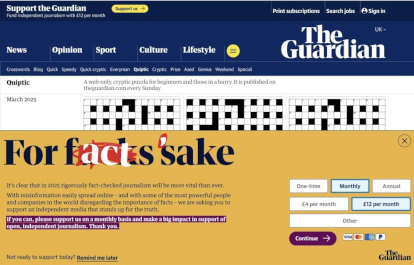
 Guardian News & Media has avoided censure by the ad watchdog over a pop-up ad that appeared on the Guardian website lauding its fact-checking journalism, which featured a headline that appeared to say “For fucks sake” but had been scribbled over and replaced by the phrase “For facts’ sake”.
Just one reader took umbrage, and rifled off a complaint to the Advertising Standards Authority, challenging whether the ad was offensive because the phrase “For facts’ sake” and the partially obscured “k” alluded to an expletive; and that the ad was inappropriate for display on a website where it could be seen by children.

In response to the ASA investigation, Guardian News & Media put up a robust defence, insisting it had used the phrase “For Facts’ Sake” in its marketing since 2021 to reflect its focus on fact-based, trusted journalism. It said it emphasised this in a playful and intelligent way, without using an actual expletive, although it alluded to one. It was also used by other broadcasters and publishers.
It claimed the phrase “For fuck’s sake” was commonly used to express frustration and annoyance, a potential reaction to misinformation. It was not associated with aggression; directed at another person or group; or derogatory or demeaning to others.
Guardian News & Media said the ad was presented only to people who had chosen to visit its website, where it had appeared since February 5 2025. Impressions of it exceeded 30 million and it had only been contacted directly with one negative response.
The website did not target those under 18 years of age and it took the view that it was not likely to be accessed by children and the content was unlikely to interest them either.
It went on to point out that the Guardian rarely shies away from expletives in its editorial, having been the first national newspaper to use the F-word nearly 65 years ago. In fact, its own internal style guide says the Guardian is “more liberal than any other newspapers, using language that most of our competitors would not”.
“Fuck” was used 2,815 times from April 28 2021 to April 28 2025 in editorial content and thus visible across its website. It regularly uses the C-word, too.
In its ruling, the ASA cited that CAP Code that states ads must not contain anything that is likely to cause serious or widespread offence, and to ensure advertising is prepared with a sense of responsibility to consumers and to society.

The watchdog also acknowledged that the ad did not explicitly use the word “fuck’s” as it was partially obscured by “facts’”. However, it considered that many people would understand “fuck’s” was implied. It also considered that many people would understand this as a play on words to position the Guardian’s journalism as based on fact.
The ASA also accepted that Guardian News & Media’s editorial policy meant that the F-word was used relatively frequently in the newspaper and website, shaping the context in which the ad was seen and influencing expectations among its readership.
It therefore considered that an obscured version of the word “fuck” reflected language used elsewhere in the website and newspaper.
Concluding that the ad was unlikely to cause serious or widespread offence and had not been irresponsibly targeted, the watchdog ruled that no further action was necessary.
Even so, the ruling contrasts sharply with BrewDog’s attempts to avoid censure. In 2020, the firm was forced to ditch a campaign that was designed to big up its environmental record, under the strapline “F**k You CO2. Brewdog Beer Is Now Carbon Negative”, despite the double asterisk.
A year earlier it was forced to rip up a poster campaign for its alcohol-free beer Punk AF – which carried the strapline “Sober as a motherfu” – after the ad watchdog branded the play on words offensive.
Related stories
Forget f**k you motherfu, only one expletive is allowed
Only fudging joking: ASA rejects ‘expletive’ complaints
‘Meditating’ Salesforce ad swerves offensive complaints