 BrewDog may have shaken off its image as the “scallywag” of UK advertising in recent times but, it seems, the firm has returned to its bad old ways with its first run-in with the ad watchdog for four years resulting in yet another campaign being ripped down.
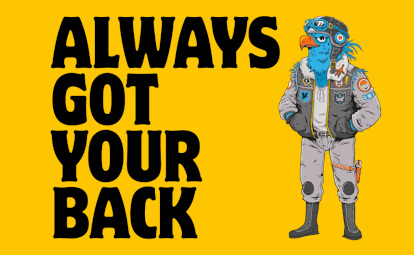
The latest issue concerns a poster for BrewDog, seen in May this year, which promoted its Wingman Session IPA beer, under the headline: “Brewdog. Always Got Your Back.”

Text underneath stated: “Some things in life go AWOL – WiFi fails, the weather turns hostile, and your buddy’s ‘five minutes’ turns into a full-scale delay. But Wingman? Wingman stands firm. Always on station, always mission-ready, always got your back. Because every great operation deserves a great Wingman.”
The poster featured images of a can of Wingman, alongside a pint glass containing the beer which was embellished with stickers including one that contained the text “Always Got Your Back”.
But one eagle-eyed complainant, who believed the ad implied that alcohol was a remedy for disappointment, suffering and isolation, challenged whether it breached the advertising code, triggering an investigation by the Advertising Standards Authority.
In its defence, perhaps unsurprisingly, BrewDog did not believe the ad breached the code. It maintained the poster did not suggest that alcohol was a solution to any form of personal, emotional or psychological difficulty.
The scenarios referenced in the ad – WiFi outages, bad weather and a friend running late – were clearly framed as mundane, everyday annoyances and not substantive problems requiring resolution. It claimed the phrase “always got your back” was a widely used idiom denoting reliability and consistency, not emotional support or problem-solving.
The firm added that it believed the ad did not imply that Wingman Session IPA provided comfort, relief or escape from any form of distress. Rather, it positioned the product as being of reliable quality, not as a remedy or coping mechanism.
It also did not believe the ad claimed or implied that Wingman Session IPA had any therapeutic or mood-altering effects. The language used – “mission-ready”, “great operation” and “Wingman” – was metaphorical and aligned with the product’s name, the firm argued, adding that those phrases evoked camaraderie and reliability, not performance enhancement or emotional transformation.
Further, BrewDog did not believe the ad suggested alcohol was essential or a priority in life, implied that alcohol resolved emotional or psychological issues or portrayed alcohol as having health or performance benefits.
The company also referred to several previous ASA rulings which it believed were relevant. It said those rulings demonstrated that metaphorical or figurative language, particularly when used to convey brand identity or product reliability, was not inherently in breach of the CAP Code unless it explicitly implied therapeutic or emotional benefits. It maintained the language used in the ad was clearly metaphorical, aligned with established ASA precedent and did not imply that alcohol was a remedy for emotional or psychological issues.

Global, the media owner, said it had received no complaints about the ad, although it had been removed from it sites.
However, the ASA was having none of it, citing the CAP Code, which states marketing communications must not imply that drinking alcohol can overcome boredom, loneliness or other problems.
The watchdog did acknowledge the ad had an air force theme; in particular, the product’s name “Wingman”, the references to “always on station, always mission-ready”, “AWOL” and “every great operation” and some of the imagery, which included the product packaging featuring a bird wearing a flying jacket, helmet and googles.
It also considered that the references to Wingman “always got your back”, in that context, suggested Wingman was reliable, dependable and supportive.
The watchdog noted BrewDog’s comments that the ad positioned Wingman Session IPA as being of reliable quality. However, it disagreed; the ad did not make any references to the product’s taste or other sensory elements that would lead to a beer being of high quality.
While the ASA also acknowledged that the scenarios presented in the ad – WiFi outages, unexpected bad weather and a friend running late – were mundane and everyday annoyances, it considered that those scenarios, were likely to result in people feeling frustrated and bored, potentially lonely and would be likely to be viewed as problematic.
In addition, the regulator said that while the ad used metaphorical language to evoke Wingman’s reliability, consistency and a sense of camaraderie, the scenarios presented were real-life problems that were likely to impact people in a negative way and the implication was that Wingman was a solution to overcoming those problems that were likely to result in boredom, frustration and potentially loneliness.
For those reasons, the ASA considered the ad implied that drinking alcohol could overcome boredom, loneliness or other problems and concluded it breached the Code.
Banning the ad from running again, the ASA went on to warn BrewDog over future activity.
Related stories
Forget f**k you motherfu, only one expletive is allowed
Only fudging joking: ASA rejects ‘expletive’ complaints
BrewDog issues ‘gold plated’ apology as ASA snarls
BrewDog ‘beer for everyone’: Is anyone miserable now?
Chastened BrewDog bows to ASA over fresh ad ban
BrewDog flayed yet again as green claim turns air blue
BrewDog ordered to clean up its act after ‘motherfu’ ad
Hopping mad: Consumers in a froth over BrewDog ads