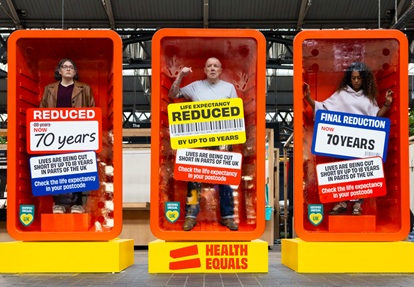
 Health Equals, the coalition of organisations that campaigns to reduce health inequalities, is launching a nationwide campaign to highlight the stark differences in life expectancy experienced across the UK.
Supported by actor Will Mellor and media medic Dr Amir Khan, “Shelf Life” has been devised by agency 23red, part of Capgemini. Using the familiar visual language of supermarket pricing labels, the creative stills and motion shows years being “reduced” from people’s lives, making visible the impact that health inequalities have.

The activity will run across social, digital, outdoor and partner channels.
The campaign is backed by a new analysis from the network – a coalition of over 125 organisations – which reveals that people in some parts of the UK can expect to live up to 18 years less than those in the healthiest communities, driven by factors such as poor-quality housing, polluted air and insecure work.
Designed to turn a complex issue into something immediate and relatable, the activity encourages people to use the Health Equals postcode checker to see how life expectancy varies where they live, and then contact their MP to support action on health inequalities.
Health Equals chief campaign officer Paul McDonald said: “We made a deliberate decision to be bold with this campaign because these figures demand attention. Raising awareness alone is not enough. We need people to stop, take notice and, most importantly, take action. At Health Equals, we take great care to test our campaigns with trusted advisory groups and people with lived experience to ensure they resonate with those most directly affected by these issues and reflect their realities authentically.

“But alongside the urgency, there must also be hope. People need to know that change is possible. That’s why we’ve been working behind the scenes with our parliamentary champions, paving the way to call for real, legislative action to change the law and make tackling health inequalities a legal duty for the government.”
23red senior creatives Ali Omar and Daryll Arthur added: “The idea of giving communities a ‘shelf life’ takes a complex issue and makes it impossible to ignore. We’re all familiar with expiry dates on everyday products, but seeing that concept applied to people’s lives creates an immediate emotional reaction. It forces us to confront the reality that in some postcodes, people can expect to live significantly shorter lives – up to 18 years less, simply because of where they are born and live.
“What makes the idea so powerful is that it translates statistics into something human and relatable. Health inequalities can often feel distant or abstract, but the shelf life concept turns those numbers into a stark, visual reminder that time is being lost.”
Related stories
AA/WARC reaction: ‘Great growth, greater expectations’
Adspend continues to climb as mail shows its mettle
Bellwether reaction: ‘The rise of the wise investment’
Ad budgets rise again as brands play the long game
AA/WARC reaction: Trust is the new advertising stardust
Industry shows its mettle as adspend hits the top corner