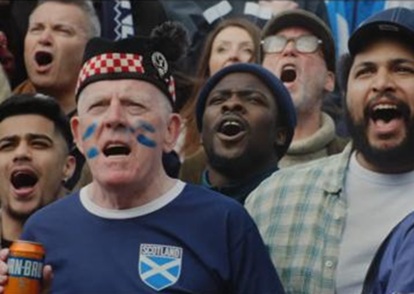
 The French might be favourites to win the World Cup but it is the Scots who have emerged as the true winners – in terms of advertising at least – with Irn-Bru topping a field of 130 World Cup-themed ads tested across the UK, US, Brazil, Europe and Australia.
That is according to a report from System1, which reveals this year’s tournament as the most competitive yet. Twenty-two ads achieved a Star Rating of 4.0 or higher, compared with just two ads during the 2022 Men’s Fifa World Cup.

While some in the industry question the validity of System1’s Test Your Ad platform, it does measure consumers’ emotional responses to advertising, assigning a score from 1.0 to 5.9 Stars based on long-term brand-building potential. Ads that generate strong positive emotions, such as happiness and surprise, are more likely to achieve higher scores.
The strongest performers combined emotional storytelling with distinctive brand assets and cultural relevance.
Irn-Bru’s winning campaign features Scottish icons, including Susan Boyle, while second place went to snack brand Lay’s, which blends former footballers David Beckham and Thierry Henry with the comedic appeal of Will Ferrell to appeal to US audiences.
Elsewhere, Lego has turned its product into the story itself with a trophy built from bricks, while Guinness has revived its “Singing Pints” creative platform.
Despite strong emotional performance across the field, brand recognition proved more challenging. One in five viewers could not recall the advertised brand after viewing, and only three campaigns in the “Winning 11” achieved exceptional fluency, System1’s measure of brand memorability.
The “Winning 11” World Cup Ads:
1 Irn-Bru (Scotland) – The Tartan Army – 5.9 Stars
2 Lay’s (US) – Bandwagon – 5.1 Stars
3 Lego (England) – Everyone Wants a Piece – 4.9 Stars
4 Guinness (England) – Singing Pints – 4.8 Stars
5 BBC (England) – 2026 Fifa World Cup Coverage Announcement – 4.8 Stars
6 EE (England) – Yes Boys – 4.8 Stars
7 Mastercard (Argentina) – For You, The Fans – 4.7 Stars
8 McDonald’s (Brazil) – As seleções do Méqui estão de volta – 4.7 Stars
9 M&S (England) – Eat Well Play Well – 4.7 Stars
10 Adidas (England) – Backyard Legends – 4.5 Stars
11 Volkswagen (Brazil) – O Sonho (The Dream) – 4.5 Stars

Paddy Power narrowly missed out on the rankings, with a 4.2-Star campaign, but has emerged as the standout performer in the betting category, one of the most polarising sectors in System1’s Test Your Ad Competitive Edge database.
Burberry and Uber Eats also stood out, each earning a 4.3-Star Rating in the typically low-emotion fashion and food delivery categories.
One of the biggest surprises was Nike’s absence from the rankings. While both Nike and Adidas generated significant attention around the tournament, Adidas ultimately won over consumers, securing ninth place with Backyard Legends and gaining the upper hand in one of advertising’s longest-running sporting rivalries.
System1 chief growth officer of advertising Andrew Tindall said: “This year’s World Cup was a reminder that great advertising isn’t about hiring the biggest celebrity, it’s about telling the best story. The winning ads used fame well, but they won because they paired it with humour, cultural relevance and strong creative execution.
“The challenge is that too many brands are still leaving memory on the table. On average, one in five viewers couldn’t recall who the ad was for. That’s a problem.
“As our Creative Dividend research with Effie shows, emotion drives growth, but only when it’s linked to the brand. You can score all the emotional goals you like, but without distinctive brand codes, you’re just hitting the post. That’s attribution lost. That’s emotional wastage.”
Related stories
Irn-Bru revives ‘Girders’ anthem for World Cup blitz
40 million UK consumers plan to watch the World Cup
Adidas ‘Backyard Legends’: A true 40-yard screamer
Industry shows its mettle as adspend hits the top corner
Coca-Cola Uncanned Emotions: Not quite ‘the real thing’
Brits set for spending spree as World Cup fever builds
Walkers kicks off World Cup ‘Epic Football Watch Party’
Pub giant Stonegate picks agency for World Cup blitz